

Screen Printing vs DTF Printing for Shirts
Table of Contents
- How Screen Printing and DTF Printing Work
- Print Quality and Design Complexity
- DTF vs Screen Printing Cost: Setup, Per-Unit, and Break-Even
- Screen Printing for Bulk Orders
- Hand Feel, Durability, and Washability
- DTF Printing on Dark Shirts
- Which Method Should You Choose?
- Frequently Asked Questions
Last Updated: October 18, 2026
How Screen Printing and DTF Printing Work
When comparing screen printing vs DTF printing, you're looking at fundamentally different technologies for getting designs onto fabric.
Screen printing uses a mesh screen with stenciled areas to push ink directly through the fabric. DTF printing (direct-to-film) transfers a design from a special film onto the garment using heat. The choice between screen printing vs DTF printing for shirts comes down to your order size, design complexity, budget, and timeline.

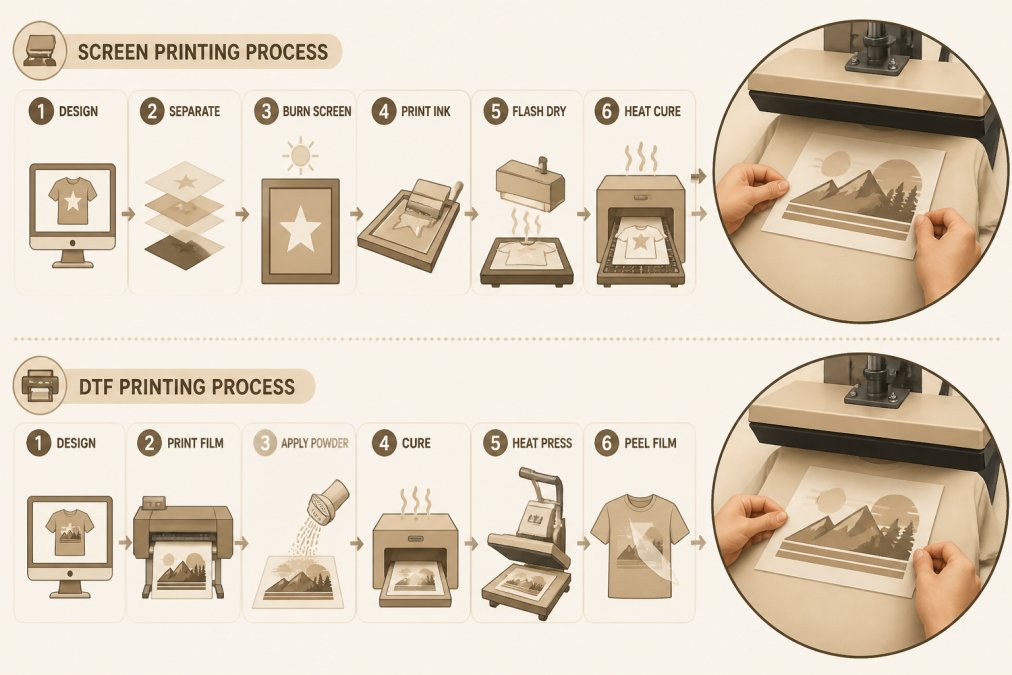
Screen Printing Process
Screen printing starts with artwork preparation: your design is separated into color layers, each needing its own screen.
During production, the screen sits on the garment and ink is pulled across the mesh with a squeegee, forcing it through the open areas onto the shirt.
Setup takes time and cost, typically a few hours per screen, but once screens are ready, printing each shirt is fast.
DTF Printing Process
DTF printing begins with your digital artwork sent to a specialized printer, which prints the design in full color onto a special film using water-based inks. A heat press then bonds the film to the garment.
The whole process happens in one workflow: no screen setup, no color separation. DTF handles gradients, photos, and complex color details without extra steps.
Print Quality and Design Complexity
Print quality differs significantly by method.
Screen printing delivers bold, vibrant colors with excellent opacity and a distinctive thick ink layer.
DTF printing handles full-color designs, photos, and gradients without limitation: a detailed landscape or a 50-color design costs the same as a simple two-color one, and resolution is higher.
For simple, bold designs with limited colors, screen printing produces superior visual impact. For complex artwork, photos, or multi-color designs, DTF printing is the only practical option.
DTF vs Screen Printing Cost: Setup, Per-Unit, and Break-Even
Cost is where screen printing and DTF printing diverge most dramatically.
The two cost structures, side by side
Screen printing has a fixed setup cost per color per print location plus a low per-unit cost. Setup covers artwork separation, emulsion coating, exposure, and screen reclaim: typically $20-$40 per color per location for basic jobs, rising to $50-$150 for complex separations or oversized prints.
DTF printing has almost no setup: most shops charge a one-time design or rip fee of $0-$15, or fold it into the per-transfer price. Per-unit cost is driven by transfer size, not color count: a standard adult front transfer prices at $4-$9 per shirt in small runs and $3-$6 at volume.
A quantity-based cost model
Use this model to estimate your own break-even. It assumes a single print location on a standard cotton tee, a 2-color screen print, and a comparable-size DTF transfer.
| Order quantity | Screen printing (2-color) | DTF printing | Lower total cost |
|---|---|---|---|
| 12 | $120 setup + $60 production = $180 | ~$96-$120 | DTF |
| 24 | $120 + $108 = $228 | ~$168-$216 | DTF (narrow) |
| 48 | $120 + $192 = $312 | ~$288-$384 | Screen (narrow) |
| 72 | $120 + $252 = $372 | ~$396-$540 | Screen |
| 144 | $120 + $432 = $552 | ~$720-$1,008 | Screen |
| 288 | $120 + $720 = $840 | ~$1,296-$1,872 | Screen |
The break-even for this 2-color, one-location example falls around 30-50 shirts. Below that, DTF's near-zero setup wins; above it, screen printing's lower per-unit cost compounds.
How color count moves the break-even
Color count is the single biggest lever: each additional screen adds setup cost but barely changes per-unit cost. A 4-color design at $30 per screen adds $120 in setup versus a 2-color design, pushing break-even to roughly 60-90 shirts; a 6-color design can push it past 100. For gradients, photos, or more than about 5 spot colors, DTF is often cheaper at every quantity a typical team or small business would order.
Print locations and garment color
- Multiple locations multiply screen setup: a front and back print on a 2-color design means four screens, not two. DTF charges per transfer, so two locations simply means two transfers.
- Dark garments add a white underbase screen in screen printing, which is effectively an extra color and an extra setup charge. DTF includes a white layer in the transfer at no added setup.
- Oversized prints can require larger screens and more ink, raising both setup and per-unit cost in screen printing; DTF transfer price scales with film size but not with color count.
What the model does not capture
Setup and per-unit costs are only part of the total. Factor in rush fees (common in both methods during peak season), garment cost (often the largest line item), and reprints if artwork changes. Screen printing reprints need new screens if the design changes; DTF reprints only need a new transfer file.
Screen Printing for Bulk Orders
Screen printing's economics make sense only at scale: once you've invested in screens, each additional shirt costs very little.
For orders of 100+ shirts, screen printing delivers lower per-unit cost than DTF.
Screen printing is also fast at scale: once screens are ready, a team can print dozens of shirts per hour, making it significantly faster than DTF for runs of 500+.
Customizable T-Shirt, Gildan Soft Style - Add your own design! →
The limitation: screen printing requires minimum order quantities. At The Goods ND, we work with orders of any size, including small batches that other printers turn away.
Hand Feel, Durability, and Washability
How a printed shirt feels and how long the print lasts matter as much as cost and appearance. Here's what's well established, what depends on your garment, ink, and care routine, and a simple wash test you can run yourself.
Hand feel: what to expect
Hand feel is the tactile difference between a print that sits on the fabric and one that is pushed into it.
- Screen printing lays down a thicker ink film. On a standard plastisol print, you feel a raised, slightly rubbery surface. Water-based and discharge screen inks penetrate the fibers and feel much softer, closer to the bare fabric, but they can be less opaque on dark garments.
- DTF printing bonds a transfer film with an adhesive layer. The result is a thin, flexible print with a soft hand feel that many people find closer to the garment than plastisol. The tradeoff is a faint film edge on some transfers, especially on stretchy or textured fabrics.
Hand feel isn't fixed by method alone: ink type, deposit, curing, and garment texture all change the result. A water-based screen print can feel softer than a DTF transfer; a heavy plastisol print can feel thicker than either.
Durability: what the claims actually mean
Durability claims are easy to make and hard to verify. Properly cured screen prints and quality DTF transfers both survive dozens of home launderings, but they fail differently:
- Screen printing tends to fail by cracking along the ink film, especially on stretchy fabrics or where the ink deposit is thick. Fading is usually gradual and driven by abrasion and UV exposure.
- DTF printing tends to fail by edge lifting or peeling if the transfer was not pressed at the correct temperature, pressure, and dwell time, or if the garment was not compatible with the adhesive. Fading and dulling can occur with repeated hot washes.
The single biggest variable in both methods is curing or pressing. Under-cured screen ink washes out; under-pressed DTF transfers peel. Garment quality matters too: a tightly knit, well-finished blank holds a print better than a loose, low-quality knit.
A simple wash-test method you can run
Rather than rely on a claim, test a sample:
- Print the same design on the same garment with each method, and keep an unwashed control sample.
- Wash in a home machine on a normal cycle with a standard detergent, warm water, and a low-heat tumble dry. Record the cycle count.
- After every 5 cycles, inspect for cracking, fading, peeling, edge lifting, and changes in hand feel. Photograph under consistent lighting.
- Stop when you see the first failure mode, and note which method reached it first and how.
Garment-specific performance
- 100% cotton: Both methods perform well. Screen printing with plastisol gives strong opacity; DTF bonds reliably to cotton.
- Polyester and performance fabrics: DTF often performs better because the low-temperature press avoids dye migration, a common problem when screen printing polyester with plastisol. Dye-sublimation is the native method for polyester, but DTF is a practical alternative for small runs.
- Cotton/poly blends: Both work, but test for dye migration on dark blends and confirm the DTF adhesive is rated for the blend.
Care guidance that actually extends print life
- Wash inside out on a cold or warm cycle with mild detergent.
- Avoid fabric softener and bleach, which degrade inks and adhesives.
- Tumble dry low or hang dry; high heat is the most common cause of cracking and peeling.
- Do not iron directly on the print; use a pressing cloth or iron inside out.
DTF Printing on Dark Shirts
One of DTF printing's biggest advantages is printing on dark fabrics without limitation.
Screen printing on dark shirts requires a white underbase: the printer applies white ink first, cures it, then prints the color design on top.
DTF printing handles dark shirts effortlessly: the film transfer includes a white adhesive layer between the design and fabric, so colors pop on black, navy, or charcoal without extra steps or cost.
If your design needs to work on both light and dark garments, DTF eliminates the complexity and cost that screen printing requires.
Which Method Should You Choose?
The decision comes down to four factors: order quantity, design complexity, budget, and timeline.
Choose screen printing if:
- You're ordering 100+ pieces
- Your design has 3 or fewer colors
- You want the boldest, most durable finish
Choose DTF printing if:
- You're ordering fewer than 75 pieces
- Your design includes photos, gradients, or many colors
- You're printing on dark shirts
At The Goods ND, we offer both methods. Our team reviews your specific project and recommends the approach that delivers the best quality at the best value for your situation.
Ready to bring your design to life? Shop now with The Goods ND and see the difference professional printing makes.
Frequently Asked Questions
Does DTF last longer than screen printing?
Both methods can be durable when done correctly. The real difference depends on garment care and the specific fabric. Quality control matters most, properly cured prints from either method should last without significant fading or peeling.
Which is cheaper: DTF or screen printing?
Screen printing typically has higher setup costs but lower per-unit costs on large orders. DTF generally has minimal setup costs but higher per-shirt expenses for small runs. For smaller orders, DTF is often more affordable. For larger orders, screen printing can become more cost-effective. The specific cost-effectiveness depends on design complexity and color count.
Can DTF print full-color designs on dark shirts?
Yes. DTF printing excels on dark fabrics because the transfer includes a white underbase that prevents colors from fading into the fabric. This means full-color, gradient, and photographic designs print with accurate color on black, navy, or colored shirts. Screen printing on dark garments requires a white base layer first, adding cost and production time. DTF's ability to handle full-color designs on dark shirts without extra steps makes it ideal for photo-realistic or multi-color artwork on darker fabrics.
How many shirts do you need for screen printing to be cost-effective?
Screen printing can become more cost-effective than DTF for larger orders, depending on your design. For bulk orders, screen printing may offer a lower per-shirt cost. If you need fewer shirts, DTF typically costs less overall. The Goods ND handles orders of any size, no minimum required, so you can choose the method that fits your budget and timeline.
Choosing between screen printing and DTF printing for shirts doesn't have to be complicated. Both methods deliver excellent results when matched to the right project. The Goods ND specializes in helping customers navigate this decision with transparent pricing, honest recommendations, and printing quality that actually holds up after dozens of washes. Get started today and experience custom apparel that reflects who you are.