

Is DTF Printing Worth It for Custom Shirts?
Table of Contents
- What DTF Printing Is and How It Works
- DTF vs. Screen Printing: Which Method Fits Your Order
- DTF vs. DTG Printing: Speed, Quality, and Cost Differences
- DTF Print Durability and Wash Care: What Actually Holds Up
- DTF Printing on Dark Shirts: Performance and Best Practices
- The Real Cost Breakdown: When DTF Makes Financial Sense
- Conclusion: Is DTF Printing Worth Your Investment?
- Frequently Asked Questions
Last Updated: October 12, 2026
What DTF Printing Is and How It Works
Direct-to-film printing, or DTF, transfers designs onto garments using film and a heat press: print onto transfer film with DTF inks, apply adhesive powder, cure it with heat, then press the film onto the garment to bond the design permanently, and whether is DTF printing worth it for custom shirts depends on your order volume and design needs.

DTF handles full-color designs with fine detail and gradients other methods struggle with. Unlike screen printing, which needs a separate screen per color, DTF prints photographic images and complex artwork in a single pass, on cotton, polyester, blends, and dark garments.
DTF requires a printer, adhesive powder dispenser, curing oven, and heat press. Setup takes time and space, so small operations may find outsourcing transfers more financial sense. At The Goods ND, we've invested in professional DTF equipment.
DTF vs. Screen Printing: Which Method Fits Your Order
Screen printing has dominated custom apparel for decades: it's cost-effective for large bulk orders and produces durable prints, but has real limitations when your design is complex or your order volume is small.
Screen printing requires a separate screen per color: a four-color logo means four screens, four setup charges, and four print passes. That makes sense at 500 shirts but is wasteful for 30.
Screen printing wins on durability and cost per unit at large volumes, and its stiffer feel suits some athletic or workwear. DTF prints feel softer and more flexible against the skin.
The break-even point depends on order size and design complexity. Simple single-color designs on large orders favor screen printing; photographic images, gradients, or small orders favor DTF.
| Factor | Screen Printing | DTF Printing |
|---|---|---|
| Setup time | 30-60 minutes per color | 10-15 minutes total |
| Cost per shirt (500+ pieces) | $3-5 | $5-8 |
| Cost per shirt (50-100 pieces) | $8-12 | $4-6 |
| Design complexity | Simple colors only | Full-color, photographic |
| Print durability | Excellent (100+ washes) | Very good (50+ washes) |
| Print feel | Stiff, raised | Soft, flexible |
| Turnaround time | 5-10 business days | 2-3 business days |
DTF vs. DTG Printing: Speed, Quality, and Cost Differences
Direct-to-garment printing, or DTG, prints directly onto fabric without transfer film, applying specialized inks and heat curing them.
DTG produces excellent color vibrancy and fine detail on light garments, rivaling DTF on cotton blends, with no film, powder, or pre-press curing. But it has real constraints.
DTG struggles with dark garments: the ink lacks opacity, so colors look muted on black or navy.
DTG also needs more maintenance: printheads clog if the machine sits idle and are expensive to replace.
Cost-wise, DTG and DTF are competitive on small orders. Both avoid setup fees and screen charges.
DTF Print Durability and Wash Care: What Actually Holds Up
Durability drives many businesses' decision: a print that cracks or fades after a few washes destroys your reputation and invites refunds. Here is how to test it, what fails, and why.
How to run your own wash test
You don't need a lab for useful data. A documented home-style test gives numbers you can trust:
- Build a sample set. Print the same design on the same blank at least five times, using your normal production settings.
- Label each shirt with a number and record the print date, ink batch, powder type, and cure temperature and time.
- Wash on a fixed cycle. Use the same water temperature, detergent, and load size every time so the only variable is wash count.
- Dry consistently. Either tumble dry low every cycle or air dry every cycle, not a mix.
- Inspect at set intervals. Check after 5, 10, 20, 30, and 50 cycles. Photograph each shirt under the same lighting.
- Score each print for cracking, peeling, color fade, and hand-feel change on a simple 1-to-5 scale.
This won't match an industry lab, but it shows how your specific ink, powder, and cure profile behave, which is what matters for your customers.
What actually fails, and why
DTF prints rarely fail all at once; they fail at the edges first, then spread inward. Common failure modes:
- Edge lift and peeling: usually an under-cured adhesive or uneven powder coverage
- Cracking across the design: typically over-stretching during pressing or a print applied too thick
- Color fade: heat and detergent breaking down the ink over many cycles
- Tacky or gummy feel: incomplete powder melt, often from curing too cool or too fast
The weak point is the adhesive powder stage: uneven powder means uneven bonding, and curing too cool leaves the adhesive unset so prints peel prematurely. Quality control here determines most of your durability outcome.
Wash care that extends print life
Prints last longer washed in cold water, turned inside-out, and dried on low heat or air-dried. Hot water, high-heat dryers, bleach, and harsh detergents break down the print over time. Clear care instructions with every order are one of the cheapest durability improvements a shop can make.
How DTF compares on durability
Screen printing holds up longest on long-run cotton because the ink fuses into the fabric with no adhesive layer to fail. DTF is close behind when cured correctly and beats DTG on dark garments, where the white underbase cracks first. Heat-transfer vinyl matches DTF on simple shapes but feels stiffer and fails faster on stretch fabrics. Sublimation is permanent on polyester but doesn't apply to cotton.
At The Goods ND, every DTF print undergoes quality control before shipping, including visual inspection for adhesive coverage and ink saturation.
DTF Printing on Dark Shirts: Performance and Best Practices
Dark garments are where DTF shines.
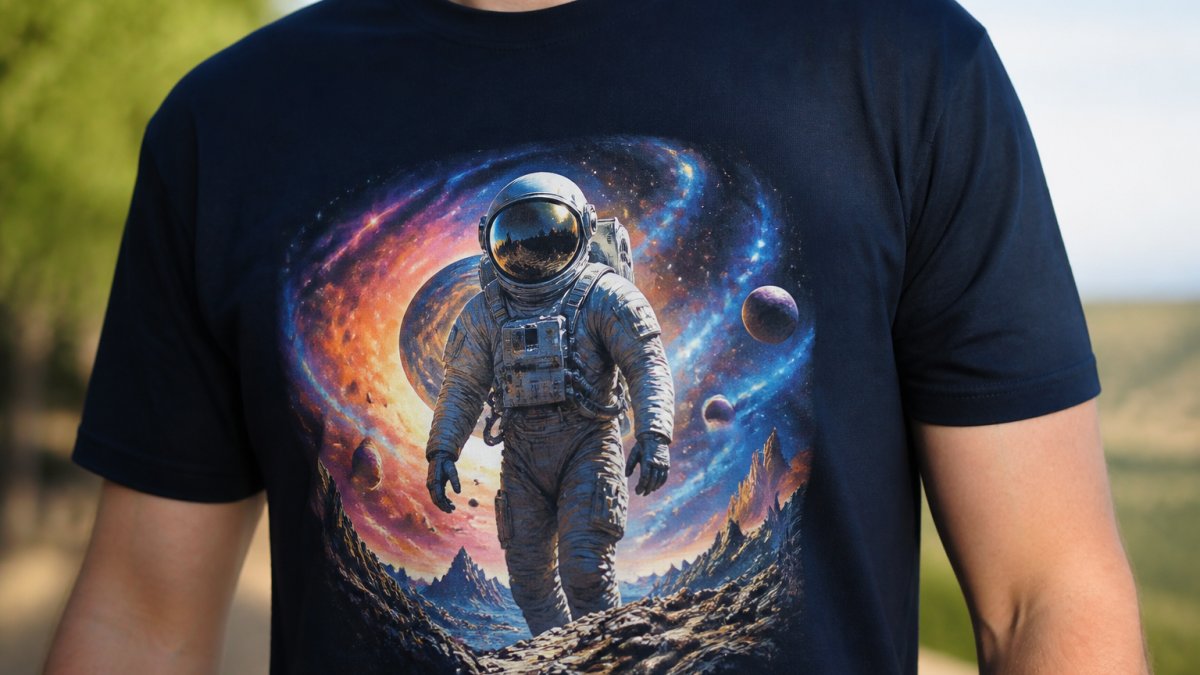
Dark garments need slightly more curing time because darker fabric absorbs more heat. Under-curing leads to tacky prints that peel within a few washes, so proper curing temperature and duration are non-negotiable.
One practical advantage: dark shirts hide minor imperfections better than light ones. A tiny adhesive gap or color variation is invisible on black but obvious on white, so dark-garment orders draw fewer appearance complaints.
Customizable T-Shirt, Gildan Soft Style - Add your own design! →
The Real Cost Breakdown: When DTF Makes Financial Sense
Whether to invest in DTF equipment or outsource transfers depends on order volume, design variety, and cash flow. Here is the actual math, plus the hidden costs that change the answer.
Equipment and startup costs
A basic in-house DTF setup runs roughly $8,000 to $20,000 depending on printer width, brand, and new versus refurbished, typically bundling four pieces of equipment:
- DTF printer (the largest line item)
- Adhesive powder dispenser or shaker
- Curing oven or heat gun setup
- Heat press
Budget separately for the first consumables order (ink, film, powder), ventilation or workspace upgrades, and a buffer for printhead replacement, the most expensive wear part.
Per-shirt cost, built from the ground up
In-house DTF cost per shirt is the sum of:
- Transfer cost: ink, film, and adhesive powder consumed per print
- Garment cost: blank shirt, which often exceeds the transfer cost itself
- Labor: design prep, printing, powdering, curing, pressing, and folding
- Failure rate: misprints, powder gaps, and under-cured transfers that get reprinted
- Overhead: electricity, maintenance, and equipment depreciation
Most small operations land at $4 to $8 per shirt for transfer and labor, before the blank. Outsourcing transfers typically costs $6 to $12 per shirt plus shipping, but removes equipment, maintenance, and failure-rate risk entirely.
Hidden operating costs competitors skip
The costs that break DTF budgets are rarely the printer:
- Ink and powder waste during color changes and end-of-roll film
- Misprint rate: a common pattern is 3 to 8 percent of transfers failing inspection, higher during the learning curve
- Maintenance: daily printhead cleaning, periodic capping station and wiper replacement
- Downtime: a clogged or failed printhead can idle production for days
- Curing energy: ovens and presses draw continuous power during a run
- Labor at scale: powdering and pressing are hands-on steps that do not automate cheaply
A shop that ignores these can show a healthy per-shirt margin on paper and still lose money over a quarter.
A transparent break-even model
You can estimate your break-even without a spreadsheet by comparing two numbers:
- Outsourced cost per shirt (transfer price plus shipping, spread across your order)
- In-house cost per shirt (transfer, labor, failure rate, and overhead)
The gap is your per-shirt savings. Divide your equipment investment by that savings to get the shirts required to pay back the machine.
Example: if outsourcing costs $9 per shirt and in-house costs $5, you save $4 per shirt.
Most practitioners find the crossover sits between 200 and 300 shirts per month for a mid-range setup, though the exact point moves with design complexity, failure rate, and how you value your labor.
Like-for-like comparison across methods
Cost only makes sense when you hold quantity, garment, and design complexity constant. For a multi-color design on a cotton tee:
| Order size | Screen printing | DTG | DTF (outsourced) | DTF (in-house) |
|---|---|---|---|---|
| 1-10 shirts | High setup, poor value | Competitive | Competitive | High fixed cost, poor value |
| 50-100 shirts | Setup fees dominate | Competitive | Strong value | Break-even zone |
| 500+ shirts | Lowest per unit | Higher per unit | Higher per unit | Competitive if volume is steady |
Screen printing wins on large runs of simple designs because setup is amortized. DTF and DTG win on small runs and complex art with no per-color setup. Sublimation only applies to polyester and light colors; heat-transfer vinyl only suits simple single-color shapes.
Our customers at The Goods ND benefit from our in-house DTF investment because we offer competitive pricing on small orders, fast turnaround, and quality control that matches our standards. We handle everything from single custom shirts to bulk patriotic apparel orders, with discounts available on major orders upon review.
Conclusion: Is DTF Printing Worth Your Investment?
Whether is DTF printing worth it for custom shirts depends on your situation.

For businesses printing fewer than 100 shirts monthly with simple designs, screen printing or outsourced DTF transfers may offer better economics. For those printing regularly with varied designs and dark-garment orders, in-house DTF equipment pays for itself.
The real question is whether DTF aligns with your production needs and order profile.
Whether you invest in your own equipment or partner with a provider, DTF printing is a proven method that delivers results, and the investment in quality always pays off in customer satisfaction and repeat business.
Frequently Asked Questions
Is DTF printing good for custom shirts?
DTF printing excels for custom shirts when you need vivid colors, fine detail, and full-color designs on both light and dark garments. It handles photographic prints and gradients well without requiring separate screens for each color. The main trade-off is startup equipment cost and per-unit labor time compared to screen printing for large bulk orders, but for small batches and complex designs, DTF delivers strong results with quick turnaround.
How long do DTF prints last on shirts?
DTF prints typically last 50-100+ washes when properly cured and cared for. Durability depends on curing temperature, adhesive powder quality, and garment care. Washing in cold water, turning shirts inside out, and air-drying extend print life. The adhesive bonds the transfer film to the fabric, creating a permanent bond if applied correctly. Poor curing or low-quality adhesive powder can lead to cracking or peeling within 10-20 washes.
Does DTF printing work on dark-colored shirts?
Yes, DTF printing works excellently on dark shirts because it uses white ink as a base layer under the color inks. This white underlay ensures vibrant colors and fine detail show clearly on navy, black, and other dark garments. The white ink is applied first, cured, then color inks print on top. This is a key advantage over DTG printing, which struggles with dark fabrics without a white pretreatment step.
Is DTF printing worth it for a small business?
DTF printing is worth it for small businesses that handle custom orders under 50 units per design or need fast turnaround times. The initial equipment investment ($3,000-$8,000) is recouped through higher profit margins on small orders where screen printing setup costs would be prohibitive. For bulk orders over 100 units, screen printing becomes more cost-effective per shirt. The decision depends on your order volume, design complexity, and customer base.