

Custom Hoodie Printing: A Step-by-Step Guide
Table of Contents
- How Custom Hoodie Printing Works
- Choosing the Right Hoodie Printing Methods
- Understanding Custom Hoodie Printing Cost
- Custom Hoodies with No Minimum Order Requirements
- Preparing Your Custom Hoodie Design
- Quality Checks and Care for Custom Hoodies
- Common Mistakes to Avoid
- Frequently Asked Questions
Last Updated: October 19, 2026
How Custom Hoodie Printing Works
Custom hoodie printing transforms a blank garment into a personalized piece that reflects your style, brand, or message. The process begins with selecting your hoodie style and color, uploading your design, and choosing a printing method. At The Goods ND, we handle the technical details so you can focus on the creative vision.

Custom hoodie printing transfers your design onto fabric using specialized equipment. Different methods work better for different designs, budgets, and durability requirements, so understanding each helps you decide before ordering.
Choosing the Right Hoodie Printing Methods
Your choice of printing method shapes everything about your finished custom hoodie. Each technique has distinct strengths, limitations, and cost implications.
Direct-to-Garment (DTG) Printing
Direct-to-garment printing sprays ink directly onto the hoodie fabric using inkjet technology. DTG excels at reproducing detailed images, gradients, and full-color photographs with precision.
DTG works best for designs with many colors or photographic details. It requires no setup fees or screens, making it ideal for small orders or one-off pieces. The ink bonds directly to fabric fibers, creating a soft feel that doesn't crack or fade quickly with proper care.
One limitation: DTG printing can struggle with very dark hoodies because the lighter ink colors don't show up as vividly. For white or light-colored hoodies, DTG delivers exceptional results. The Goods ND uses DTG technology to bring detailed artwork and photographs to life on custom hoodies.
Screen Printing
Screen printing pushes ink through a mesh screen onto the fabric, creating bold, durable designs. It has been the industry standard for decades, producing vibrant colors and excellent saturation, especially on dark hoodies.
Screen printing requires creating a separate screen for each color in your design, which means setup costs. This makes it more economical for larger orders where you're printing the same design multiple times. A single-color logo on 50 hoodies costs less per unit than printing that same logo on five hoodies.
The finished design feels slightly raised because screen printing ink sits on top of the fabric rather than absorbing into it, giving designs a distinctive appearance that lasts through hundreds of washes.
Embroidery
Embroidery stitches your design directly into the hoodie fabric using colored thread, creating a three-dimensional, professional appearance. Embroidered logos look premium and suggest quality craftsmanship.
Embroidery works best for logos, text, and simple graphics with fewer than eight colors; complex photographic designs don't translate well. The stitching process also takes longer than printing, affecting turnaround time for larger orders.
Embroidered designs are exceptionally durable. They won't crack, fade, or peel. Athletes, construction crews, and outdoor enthusiasts often choose embroidery for work gear and team apparel because embroidered logos survive years of heavy use. The investment in embroidery pays off when durability matters most.
Sublimation and DTF Transfers
Sublimation transfers heat-set dye onto the hoodie using pressure and temperature. DTF (direct-to-film) transfers print your design onto a special film, then heat-press it onto the garment. Both produce full-color designs with excellent detail and color accuracy.
Sublimation works best on light-colored hoodies because the dye becomes part of the fabric. DTF transfers work on both light and dark hoodies, making them more versatile. Both methods avoid the setup fees that screen printing requires, so they're practical for small orders.
These methods create soft designs that don't crack or peel, and the fabric retains its natural feel without the raised texture of screen printing or embroidery.
Understanding Custom Hoodie Printing Cost
Custom hoodie printing costs depend on the garment price, printing method, design complexity, order quantity, and any additional customization. Understanding these components helps you budget accurately and avoid surprises at checkout.
Hoodie base prices vary by brand and quality. A basic Gildan hoodie starts lower than a premium Bella+Canvas option.
Printing setup fees apply primarily to screen printing. Creating screens costs money upfront but spreads across your entire order. If you're printing 100 hoodies with one design, the per-unit cost drops significantly compared to printing five hoodies.
Design complexity affects pricing in some methods. Screen printing charges per color because each color requires a separate screen, while DTG doesn't charge per color.
Order quantity influences unit pricing substantially. Most custom apparel printers offer volume discounts. Ordering 200 hoodies costs less per unit than ordering 20.
| Printing Method | Best For | Setup Fees | Color Limit | Typical Range |
|---|---|---|---|---|
| DTG | Photos, complex designs | None | Unlimited | $25-45 per hoodie |
| Screen Printing | Logos, solid colors | $50-150 per color | 1-8 colors | $15-35 per hoodie |
| Embroidery | Logos, text | $40-80 | Thread colors vary | $20-40 per hoodie |
| DTF Transfers | Full-color designs | None | Unlimited | $18-38 per hoodie |
Additional costs might include rush fees for faster turnaround, shipping charges, and design services if you need professional help creating your artwork. Ask about these upfront so your total cost matches your budget.
Custom Hoodies with No Minimum Order Requirements
Many custom apparel printers enforce minimum order quantities, typically 12 to 50 pieces, to protect profit margins on screen printing's expensive setup. Small orders become uneconomical when you're paying for screens that won't be reused.
The Goods ND operates differently. We work with orders of any size because our printing methods, sublimation, DTF, and screen printing, accommodate small quantities without penalizing you. Whether you need one custom hoodie for yourself or 300 for your organization, we handle your order with the same quality standards.
This flexibility matters for small church groups, family reunions, and individual gift-givers who don't need to buy in bulk. Startups can test a small batch before committing to larger runs, and teams can order exactly what they need rather than overbuying.
No minimum order requirements mean you're not stuck with 50 hoodies when you only needed 10, which works especially well for personalized gifts, limited-edition designs, and small events.
Customizable T-Shirt, Gildan Soft Style - Add your own design! →
Preparing Your Custom Hoodie Design
Your design quality directly impacts your finished hoodie. A blurry image, low-resolution artwork, or poorly formatted file results in disappointing output, so proper preparation ensures your vision translates accurately to the garment.
File Preparation and Artwork Specifications
Start with the highest-quality image or artwork available. For photographs, use the original file from your camera or phone rather than a screenshot or social media download. Original files contain far more detail and color information than compressed versions.
Image resolution matters significantly. Digital images are measured in pixels per inch (PPI). For custom hoodie printing, aim for at least 300 PPI at your desired print size (Standard DPI & Image Resolution for Quality Printing).
File format affects compatibility with printing equipment. JPG and PNG files work universally, while TIFF preserves quality at larger file sizes. Vector files (AI, EPS, SVG) are ideal for logos and graphics because they scale to any size without losing quality.
Color mode influences how your design prints. RGB (red, green, blue) is standard for digital screens but prints differently than CMYK (cyan, magenta, yellow, black).
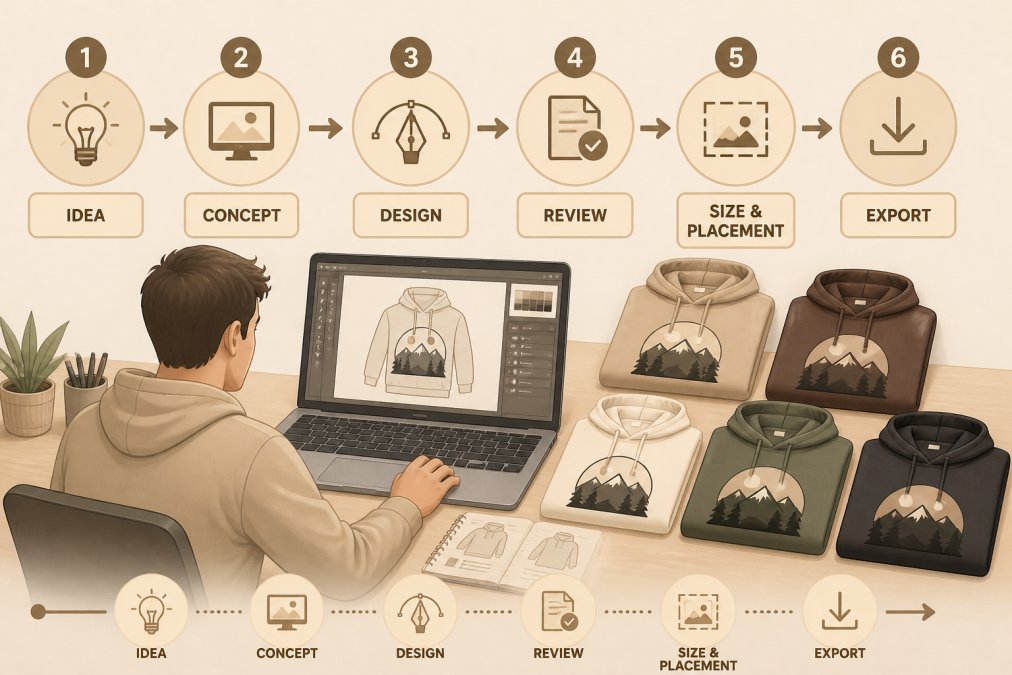
Using an Online Design Tool
Online design tools eliminate the need for graphic design software or professional designers. These platforms provide templates, fonts, and design elements formatted for apparel printing: upload your image, position it on the hoodie mockup, adjust colors and size, and preview before ordering.
The Goods ND's design studio lets you see exactly how your design looks on your chosen hoodie color and style. This preview prevents surprises. You can experiment with placement, adjust sizing, and try different color combinations. The mockup shows you the finished product before production begins.
Design tools typically include libraries of fonts, graphics, and background patterns, so you can add text, layer elements, and create complex designs without experience. Most offer undo functions, so experimenting costs nothing.
Save your design file once you're satisfied. Many platforms allow you to save and return to designs later, which helps if you want to order the same design again or make adjustments. Download your final artwork in the recommended format for your chosen printing method.
Quality Checks and Care for Custom Hoodies
The Goods ND inspects every order for print clarity, color accuracy, and stitching integrity, verifying that designs are positioned correctly and that ink or thread adhesion meets durability standards.
When your custom hoodies arrive, inspect them immediately. Check that the design matches your preview, colors are vibrant, and there are no printing defects. Look for loose threads, misaligned prints, or color fading.
Proper care extends your custom hoodie's lifespan significantly. Wash in cold water with similar colors, turn the hoodie inside out to protect the printed design, and avoid bleach and fabric softener.
For embroidered hoodies, the same care applies. Cold water, inside-out washing, and air drying protect the stitching. Embroidery is more durable than printing, so it tolerates more aggressive washing, but gentle care still extends its life.
Store clean, dry hoodies in a cool place away from direct sunlight. Sunlight fades colors over time, regardless of printing method. Proper storage preserves your custom design for years of wear.
Common Mistakes to Avoid
Uploading low-resolution images is the most common mistake. Images grabbed from social media or email are compressed for file size; they look fine on a phone screen but print blurry and pixelated.
Choosing the wrong printing method wastes money and produces poor results: screen printing a photograph looks worse than other methods, and a complex gradient doesn't work with some techniques. Match your design type to the appropriate method before ordering.
Underestimating design placement matters more than many people realize. A design positioned too close to seams, armholes, or the hoodie drawstring can look awkward or become uncomfortable to wear. Preview tools show placement, so use them.
Ignoring file specifications creates problems during production. Uploading a 72 PPI image when 300 PPI is required results in printing delays or quality issues. Reading the printer's file requirements before uploading saves time and frustration.
Ordering without checking the return policy leaves you without recourse if something goes wrong. Know the timeframe for reporting issues and what constitutes a valid complaint.
Custom hoodie printing brings your vision to life with professional quality and personal meaning. The Goods ND combines multiple printing techniques, screen printing, UV, DTF, and sublimation, with no minimum order requirements, so your custom hoodie project works at any scale.
Frequently Asked Questions
How much does custom hoodie printing cost?
Custom hoodie printing cost depends on the printing method, hoodie quality, design complexity, and order quantity. Screen printing can be more cost-effective per unit for large orders, while methods like DTF and sublimation work well for small runs without setup fees. The Goods ND provides transparent pricing on their website, and bulk orders qualify for discounts. Get a quote based on your specific design, hoodie style, and quantity to see exact pricing for your project.
Which printing method is best for custom hoodies?
The best hoodie printing method depends on your design and order size. Screen printing is ideal for bold, single-color or limited-color designs in bulk quantities. Sublimation and DTF transfers work well for full-color, all-over designs. The Goods ND offers DTF, screen print, UV, and sublimation methods, discuss your design with them to choose the right approach for your needs.
Can you order custom hoodies with no minimum quantity?
Yes, The Goods ND accepts custom orders with no minimum quantity requirement. Whether you need one hoodie for yourself or 30 for a small church group, you can place an order without hitting large minimum thresholds. This flexibility makes custom hoodies accessible for personal projects, small events, and organizations without bulk commitments. Larger orders do qualify for discounts, so bulk pricing improves as your quantity increases.
How long does custom hoodie printing take?
Turnaround time for custom hoodie printing typically ranges from a few days to two weeks, depending on the printing method, order complexity, and current production volume. The Goods ND offers fast turnaround times and can discuss your deadline when you place your order. Always confirm expected delivery dates before finalizing your order to ensure it meets your event or deadline needs.