

How to Choose Custom Apparel for Outdoor Construction Crews
Last Updated: October 30, 2026
Quick Summary
Choose custom apparel for outdoor construction crews by first listing each role's hazards, weather exposure, and tasks, then matching garments to those needs. Heavy, double-stitched shirts suit daily wear, FR or hi-vis garments suit electrical and traffic exposure, and layering handles cold weather.
- Start by listing hazards, weather, and tasks for each role before choosing garments.
- Heavy fabric and double-stitched seams help work shirts last under daily use.
- Lightweight, breathable fabric with vents suits hot-weather crews.
- FR and hi-vis are separate specifications, so check each label's standard and rating.
- Match the arc rating to the calculated incident energy from an arc flash study.
Table of Contents
- Choosing Durable Work Shirts for Construction Crews
- Construction Workwear for Hot Weather: Breathability and Heat Management
- Cold Weather Clothing for Construction Workers: Building a Layering System
- Flame Resistant and High-Visibility Requirements
- Custom Workwear Printing Methods and Their Trade-Offs
- Ordering Checklist for Your Crew, From Sizing to Wash Life
- Frequently Asked Questions
Choosing custom apparel for outdoor construction crews starts with the job, not the logo. A framer on a roof in July needs different gear than an electrician working near energized equipment in January. Selecting the right gear starts with that reality, and it's where you should begin too.
Before you pick a shirt, a coverall, or a print method, list what your crew actually does each day. Ask three questions:
- What hazards are present? Cuts, heat stress, arc flash, flying debris, or contact with machinery.
- What weather will they face? Sun, wind, rain, mud, and temperature swings across the season.
- What tasks do they perform? Climbing, kneeling, lifting, or standing for long shifts.
Each answer narrows your options. A crew doing electrical work needs flame-resistant (FR) garments, while a landscaping crew may need breathable fabric more than anything else. Write the answers down for each role on the team. You will use them again when we get to sizing and ordering.
Watch out: Don't assume one garment covers every role. A lineman and a site laborer may share a logo but need very different protection.
Choosing Durable Work Shirts for Construction Crews
Durable work shirts for construction crews need heavy fabric, reinforced seams, and colors that hold up to sun and repeated washing. Most crews wear the same shirt five days a week, so garment lifespan matters more than the price tag on day one.
Look for these features when comparing options:
- Fabric weight: Heavier cotton and blends resist tears from tools and rough surfaces.
- Stitching: Double-stitched seams last longer under stress.
- Fit: Mobility matters for reaching, bending, and lifting.
- Comfort: Breathable fabric helps during long shifts.
Our Men's Customizable FR Long Sleeve Shirt is built for crews who need dependable workwear. It includes a chest pocket for small essentials and supports custom logo embroidery, so every worker can represent your company on the jobsite. It is priced at $32.47. For a heavier-duty FR option, our Men's Customizable FR Long Sleeve Shirt, 88/12 offers a classic button-front design with dual chest pockets and six colors, priced at $47.00.


Consistent sizing is the other half of durability. A shirt that fits well gets worn and cared for. A shirt that pulls at the shoulders gets left in the truck.
Construction Workwear for Hot Weather: Breathability and Heat Management
Construction workwear for hot weather should prioritize lightweight, breathable fabric that moves moisture away from the body. Heat stress builds quickly on exposed job sites, and clothing is one of the few controls a crew can adjust right away.
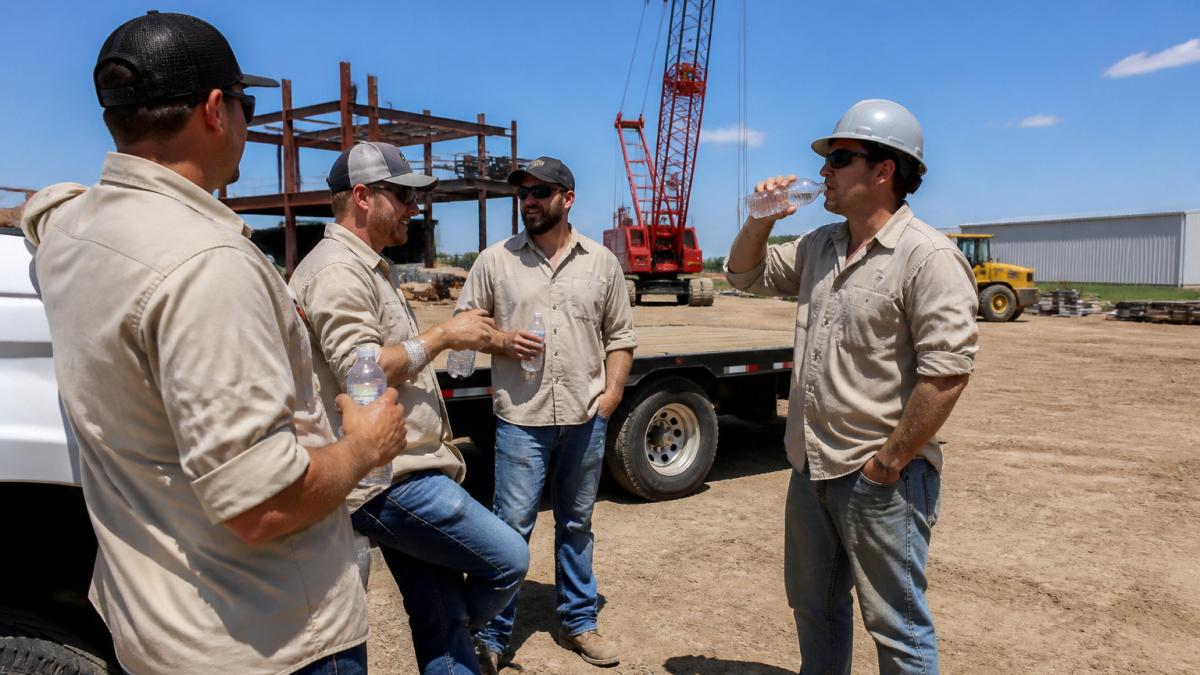
Here is what to check for hot-weather crews:
- Lightweight fabric: Lighter weights stay cooler, though they may tear more easily.
- Moisture-wicking blends: These help sweat evaporate instead of soaking in.
- Long sleeves with vents: Long sleeves protect from sun, and vents release heat.
- Light colors: Lighter shades reflect more sun than dark ones.
A common mistake is buying heavy FR gear for summer crews without considering airflow. FR protection still matters in hot months if the work involves electrical or arc-flash risk, so the answer is to choose a lighter FR weight rather than skip protection.
Our FR Hi-Vis Pearl Snap Work Shirt is 7 oz, with action back pleats that let workers reach overhead. It comes in 11 colors and sizes S to 4XL, priced at $56.81. If your crew layers it or sends it through industrial laundry, order one size up.

Cold Weather Clothing for Construction Workers: Building a Layering System
Cold weather clothing for construction workers works best as a layering system: a base layer, an insulation layer, and an outer layer that blocks wind and moisture. Layers let workers add or remove clothing as their body heat changes during a shift.
A simple three-layer approach:
- Base layer: Close to the skin, moves sweat away from the body.
- Insulation layer: A fleece or light jacket that traps warm air.
- Outer layer: A wind- and water-resistant shell for weather protection.
Workers often overdress in the morning and sweat by midday. Layering avoids that problem because a crew member can shed one piece without losing protection. Plan for the coldest hour of the day, not the average temperature. Many crews also keep a spare shirt in the truck for workers who get wet.
Note that a layering system must still meet the safety requirements for the task. If an FR garment is required, every layer worn over or under it must be compatible with that rating, so check the garment specifications before adding anything.
Flame Resistant and High-Visibility Requirements
Flame resistant (FR) and high-visibility (hi-vis) clothing protect workers from different hazards, and some tasks require both. The mistake most crews make is treating these as a single checkbox.
Men's Customizable FR Long Sleeve Shirt →
When hi-vis is actually required. Where workers are exposed to moving vehicles, equipment, or low-light conditions, hi-vis apparel is a common control.
When FR is required. FR garments are specified where workers face arc flash or flash fire exposure. The key number on the label is the arc rating, expressed as ATPV in cal/cm².
The overlap problem. FR and hi-vis are not the same rating, and a garment that is one is not automatically the other.
Decoration and compliance. Printing or embroidery can affect a garment's protective performance if it covers reflective material, adds flammable components, or changes the fabric's behavior.
Verification checklist before you order:
- Confirm the hazard assessment for each role (traffic exposure, arc flash, flash fire).
- Match the hi-vis class to the site's traffic and lighting conditions.
- Match the arc rating (cal/cm²) to the calculated incident energy.
- Confirm FR-rated reflective tape on any garment used near arc flash.
- Get written confirmation that decoration does not void the rating.
- Keep the garment labels and spec sheets on file for inspections.
The article's key specifications for FR and hi-vis garments, as stated in the section, are summarised below.
| Item | Value | Note |
|---|---|---|
| ANSI/ISEA 107 Class 2 | Common baseline | For workers near traffic |
| ANSI/ISEA 107 Class 3 | Higher-visibility option | Adds sleeves and more visible material |
| FR Hi-Vis Pearl Snap Work Shirt | ATPV 11 cal/cm² | Arc rating on label |
| FR Hi-Vis Coverall | ATPV 12 cal/cm², CAT 2 | Class 3 with 2-inch FR reflective tape |
| Arc rating | Must meet or exceed incident energy | Determined by an arc flash study |
Custom Workwear Printing Methods and Their Trade-Offs
Custom workwear printing methods each suit different designs, fabrics, and order sizes. The right choice depends on what you are printing, how often the garment will be washed, and how much detail the design needs. On construction crews, the deciding factor is usually wash life and how the decoration feels against the skin during a long shift.
The Goods ND offers multiple printing methods, including:
- DTF (direct-to-film): Flexible for full-color designs on many fabrics, with good wash durability.
- Screen print: Strong and cost-effective for large orders of simple, solid-color designs.
- UV printing: Useful for detailed graphics on a range of materials.
- Sublimation: Best for polyester fabrics, with vibrant colors that do not crack.
- Laser engraving: Available as a customization option for certain items.
How the methods compare on the factors that matter.
Laser engraving is permanent by nature but only works on materials that can be marked.
- Comfort: Embroidery adds a raised texture that some crews prefer for logos but can chafe under a harness strap.
- Fabric compatibility: Sublimation works only on polyester, so it will not suit dark cotton work shirts. Screen print and DTF handle cotton and blends well. UV printing is versatile across materials but is typically used for hard goods and specialty items rather than shirts.
- Detail and color: DTF handles fine detail and full-color gradients better than screen print, which needs a separate setup for each color. For simple one- or two-color logos, screen print is the more economical choice at volume.
- Order size: Screen print rewards larger orders because the setup cost is spread across more pieces. DTF has a lower setup barrier and suits smaller or mixed orders.
Embroidery on workwear. Embroidery is an option for adding logos to workwear. Our FR shirts support custom embroidery with company logos, employee names, or department text, which many crews prefer for a clean, professional look. See custom FR shirt logo options for the choices available. Keep embroidery off reflective tape and confirm with the manufacturer that placement does not affect an FR or hi-vis rating.
A simple selection rule:
- Simple one- or two-color logo on cotton or blend shirts at volume: screen print.
- Full-color or detailed logo on mixed fabrics and smaller orders: DTF.
- Logo on polyester performance wear: sublimation.
- Logo that must never fade or peel: embroidery.
Ordering Checklist for Your Crew, From Sizing to Wash Life
Before you place a crew order, work through a simple checklist. Good planning prevents mistakes that cost time and money.
- Confirm the hazards for each role (heat, arc flash, cuts, visibility).
- Choose the garment type for each task, such as shirt, coverall, or layer.
- Verify FR and hi-vis ratings against the standards your job requires.
- Order sizes by role, and add one size up for layered or industrially laundered gear.
- Select the decoration method and confirm it is compatible with the garment's rating.
- Plan quantities with a few spares for new hires and damaged pieces.
- Ask about wash life. Check how many washes the decoration and fabric should withstand.
Follow the care instructions on each garment: wash in mild temperatures with a mild detergent. Replacing workwear on a regular schedule keeps your crew protected and presentable.
Discounts on major orders are available upon review, so ask us about pricing for your crew order. Read how to order custom shirts with no minimum order to see how quantities affect what you buy. Shop now to start building a crew uniform that holds up on the job.
Frequently Asked Questions
What clothing is best for outdoor construction workers?
The best outdoor construction clothing is a layered system: a moisture-wicking base, a durable work shirt or coverall as the mid layer, and a windproof, waterproof outer shell when weather demands it. Cotton-blend twill and poly-cotton fabrics hold up well to abrasion and repeated industrial washing. For crews needing arc flash protection, The Goods ND's FR Hi-Vis Coverall (88/12 cotton-nylon, 7 oz, CAT 2, ANSI Class 3) at $153.54 combines flame resistance with reflective visibility, while the Men's Customizable FR Long Sleeve Shirt starts at $32.47 for everyday crew wear.
What fabric is best for construction work shirts?
Most crews choose a cotton or cotton-blend twill, typically between 6 and 8 oz, because it resists tearing and breathes well in warm conditions. Blends with nylon add abrasion resistance, while polyester blends dry faster. If flame resistance is required, the fabric must be FR-rated, and the FR Hi-Vis Pearl Snap Work Shirt ($56.81) uses 100% cotton at 7 oz with a CAT 2 rating. Always confirm the rating on the garment, since performance varies by product.
How do you choose durable custom work shirts for a construction crew?
Start with the tasks: check fabric weight, seam strength and reinforcement at stress points like shoulders and knees. Order one size up if shirts will be layered or go through industrial laundry, and test a single shirt through several wash cycles before committing to a full crew order. The Men's Customizable FR Long Sleeve Shirt, 88/12 at $47.00 is available in six colors with optional embroidery.
How many work shirts should a construction crew member have?
A common approach is three to four shirts per worker so that one is always clean while others are in the wash. Crews working in hot or dusty conditions may need more. Count FR-rated shirts separately, since they must be laundered according to care instructions that preserve flame resistance. Plan your order quantity around rotation, not just headcount, and reorder before the existing stock shows wear.
