

Custom FR Shirts With Company Logo: 10 Options
Last Updated: October 23, 2026
Quick Summary
Custom FR shirts with company logo combine flame-resistant workwear compliance with branded uniforms that represent your business on the jobsite. Choose between embroidery for durability or printing for complex designs, then select your base shirt based on your crew's heat hazard level and environment.
- Embroidery lasts longer through industrial laundering; printing works better for multi-color or photographic logos
- Left chest is standard logo placement; avoid obscuring safety markings or reflective tape on hi-vis shirts
- ATPV ratings range from 11 to 13 cal/cm²; match your shirt's rating to your crew's arc flash category (CAT 1, 2, 3, or 4)
- FR shirt prices start at $32.47 for entry-level options and reach $56.81 for hi-vis models with reflective tape
- Small orders welcome with no minimum quantity requirements or hidden setup fees
Table of Contents
- Why Custom FR Shirts With Company Logo Matter for Your Crew
- Quick Comparison: FR Shirt Options and Pricing
- Custom Flame-Resistant Shirts With Logo: Embroidery vs. Printing
- FR Shirt Embroidery: Professional Logo Application
- FR Shirt Printing: When to Use Heat Transfer and DTF
- FR Shirt Logo Placement: Best Practices for Visibility and Safety
- Understanding FR Certifications and Garment Labeling
- How to Order Custom FR Shirts: Upload Your Logo and Choose Your Fit
- Frequently Asked Questions
Why Custom FR Shirts With Company Logo Matter for Your Crew
Your team's workwear does more than keep them safe, it represents your business on every jobsite. When your crew wears custom FR shirts with company logo embroidery, they look organized and professional, which builds brand visibility and signals to clients that you run a tight operation.
For construction crews, electrical teams, welding shops, and industrial workers, flame-resistant workwear is non-negotiable. NFPA 2112 and ASTM F1506 compliance aren't optional in hazardous environments. But compliance doesn't have to mean generic, unmarked shirts, custom FR shirts with company logo embroidery let you meet safety standards while strengthening your brand identity.
At The Goods ND, we've helped crews outfit their teams with custom FR workwear that looks sharp and performs under pressure. Whether you're a crew of five or a workforce of fifty, the right strategy saves time, reduces confusion about what people should wear, and makes your operation look professional. Here's what matters when choosing custom FR shirts with company logo designs for your team.
Quick Comparison: FR Shirt Options and Pricing
| Shirt Type | Starting Price | Best For | Key Feature |
|---|---|---|---|
| Men's Customizable FR Long Sleeve | $32.47 | Budget-conscious teams | Entry-level FR with custom embroidery |
| 88/12 Cotton-Nylon FR Shirt | $46.48 | Durability priority | Outlasts straight cotton, ATPV 12 |
| 100% Cotton Lightweight FR | $44.40 | High-heat environments | Nine colors, ATPV 11 rating |
| FR Two-Tone Western Shirt | $46.48 | Aesthetic + compliance | Twelve color combos, professional look |
| Heavyweight FR Welding Shirt | $47.20 | Maximum protection | Highest arc rating (ATPV 13) |
| FR Hi-Vis Pearl Snap Work Shirt | $56.81 | Outdoor visibility | Reflective tape meets ANSI/ISEA 107 |
The choice comes down to three factors: your environment's heat hazard level, how long the shirt must last, and whether visibility matters. A welding shop faces higher arc flash environments than a construction crew. Roadside or night crews need reflective tape. Outdoor teams benefit from the 88/12 blend, which resists shrinkage better than 100% cotton.
Custom Flame-Resistant Shirts With Logo: Embroidery vs. Printing
After choosing your base shirt, the most important decision is how to apply your logo. Embroidery and printing each have different strengths.
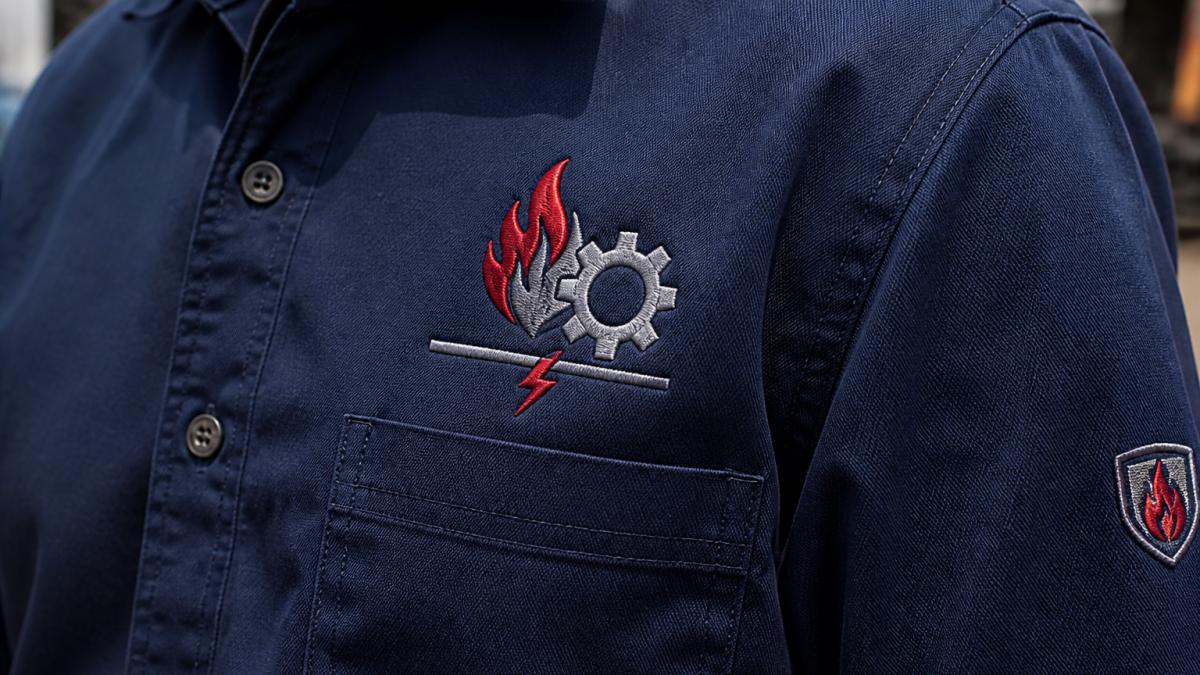
Embroidery is the traditional choice for workwear because it lasts. Thread stitched directly into the fabric doesn't crack, fade, or peel, and it survives industrial laundering and harsh jobsite conditions. The downside: embroidery works best with simpler designs.
Printing methods like heat transfer and direct-to-fabric (DTF) work better for complex, multi-color designs. The tradeoff: printed logos can crack or fade after repeated washing, and in industrial laundry environments printing degrades faster than embroidery.
Most work crews choose embroidery for longevity.
FR Shirt Embroidery: Professional Logo Application
Embroidery places your company logo directly onto the fabric using thread. The result is a raised, tactile logo that looks professional and holds up to hard use.
The embroidery process starts with digitizing your logo, converting your logo file (usually a JPG, PNG, or vector file) into stitch data an embroidery machine can read.
Once digitized, your logo gets stitched onto the shirt, thread by thread.
Placement matters. Some add back neck embroidery with the company name or a secondary logo. Sleeve embroidery is possible but less common because sleeves move more and stitches can snag.
Embroidery durability on FR shirts depends on thread quality and stitch density.
FR Shirt Printing: When to Use Heat Transfer and DTF
Printing applies your logo to the shirt surface using ink or dye. Unlike embroidery, it doesn't puncture the fabric, so it can capture fine detail and complex colors that embroidery cannot.
Heat transfer printing presses a pre-printed design onto the shirt using heat and pressure, producing a smooth, detailed logo. It's fast and ideal for one-off orders or small runs.
The limitation of heat transfer is durability. The transfer sits on the fabric surface, so after repeated washing the ink can crack and peel.
Direct-to-fabric (DTF) printing sprays ink directly onto the fabric and cures it with heat, bonding with the fibers rather than sitting on top. It handles more washing cycles and reproduces complex designs with excellent color accuracy.
The real constraint with printing on FR shirts is the fabric itself. Flame-resistant coatings and treatments can interfere with how ink bonds to the surface.
FR Shirt Logo Placement: Best Practices for Visibility and Safety
Logo placement on a custom FR shirt affects both visibility and safety.
The left chest is the standard placement: visible when facing someone, easy to embroider or print, and clear of safety markings or reflective tape.
Back neck embroidery adds the company name or a secondary logo and another branding touchpoint without conflicting with safety requirements.
Men's Customizable FR Long Sleeve Shirt →
Sleeve embroidery is possible but less common because sleeves move more, stressing stitches.
Avoid placing logos over pockets or safety markings. A logo over a chest pocket looks cluttered, and logos must never obscure reflective tape or FR safety labels.
For hi-vis FR shirts, place logos above or below the reflective stripe, never across it, a logo that obscures reflective tape defeats the purpose of wearing hi-vis gear.
Understanding FR Certifications and Garment Labeling
Flame-resistant workwear is about meeting safety standards that protect your crew. Understanding FR certifications helps you choose the right shirt for your environment.
The two main standards for FR workwear in the United States are NFPA 2112 (arc flash and flash fire protective apparel) and ASTM F1506 (protective apparel for workers exposed to electric arc). Many FR shirts meet both.
Certifications are measured using ATPV (Arc Thermal Performance Value), in calories per square centimeter (cal/cm²), the maximum heat energy the fabric can withstand before causing a second-degree burn. ATPV 11 cal/cm² protects against a smaller arc flash; ATPV 13 cal/cm² suits higher-risk environments.
FR shirts are also rated by CAT (Category): CAT 1 for low-risk environments, CAT 2 for moderate arc flash hazards, and CAT 3 and CAT 4 for high-risk environments like utilities and power generation. Most industrial and construction crews wear CAT 2; welding shops and electrical contractors often need CAT 2 or higher.
Every FR shirt should carry a label showing its ATPV rating, compliance standards, and care instructions. Hot water or bleach can damage the FR treatment, so always follow the care label.
For detailed guidance on FR printing techniques and certifications, read our complete guide to printing on flame resistant clothing. That resource covers the technical requirements and how to ensure your custom embroidery or printing doesn't compromise the shirt's FR rating.
How to Order Custom FR Shirts: Upload Your Logo and Choose Your Fit
Ordering custom FR shirts with company logo is straightforward when you know what to prepare.
Start by gathering your logo file: a high-resolution version, ideally 300 DPI or higher. Vector files (AI, EPS, PDF) work best because they scale without losing quality; if you only have a JPG or PNG, make sure it's at least 1000 pixels wide.
Next, decide on your base shirt based on heat hazard, wash frequency, and look. A construction crew in moderate heat might choose the 88/12 Cotton-Nylon FR Work Shirt at $46.48 for durability; a welding shop needing maximum protection might choose the Heavyweight FR Welding Shirt at $47.20; teams needing visibility can pick the FR Hi-Vis Pearl Snap Work Shirt at $56.81 with ANSI/ISEA 107 reflective tape.
Choose colors that match your crew's uniform requirements or company branding. For a large team, pick one or two colors to keep the order simple and costs predictable.
Decide on logo placement, chest is standard, back neck is common for secondary branding, and sleeves cost more. Communicate your preference clearly when you submit your order.
When you're ready to order, explore our customizable FR long sleeve shirt options to see what's available. You can upload your logo directly and preview how it will look on your chosen shirt. Our print-to-order apparel service handles the entire process from design upload to production to shipping.

If you're concerned about minimum order quantities, don't be. We work with crews of any size. Whether you're ordering one shirt or one hundred, there's no penalty. Learn more about ordering custom shirts with no minimum order to understand how this works.
Once your order is submitted, we'll review your artwork and confirm the final design. If your logo is too small, too detailed for embroidery, or placed in a way that might cause problems, we'll flag it before production. Every order goes through quality control to ensure your custom FR shirts meet our standards and yours.
Turnaround depends on order size and customization complexity: small orders typically ship within 5-7 business days, and larger orders may take longer.
Custom FR shirts with company logo turn standard workwear into branded uniforms that protect and represent your crew. Whether you choose embroidery for durability or printing for design complexity, the right strategy strengthens your brand while meeting critical safety standards. The Goods ND makes it simple: upload your logo, choose your shirt, and we handle the rest. Get started with The Goods ND print-to-order apparel service and outfit your team with custom FR shirts that stand out on the jobsite.
Frequently Asked Questions
Can you add a company logo to an FR shirt?
Yes. Custom FR shirts with company logo embroidery are a standard offering. You upload your logo during checkout, and the embroidery is applied professionally before shipment. The Men's Customizable FR Long Sleeve Shirt ($32.47) and Men's Customizable FR Long Sleeve Shirt 88/12 ($47.00) both support full custom embroidery with your company branding, employee names, or department markings.
What's the difference between embroidery and printing on FR shirts?
Embroidery uses thread stitched into the fabric and is more durable through repeated washing and industrial laundering. Printing applies ink or heat transfer directly to the surface.
Where should a company logo go on an FR work shirt?
The chest is a common placement for company logos on FR work shirts, it's visible, professional, and doesn't interfere with safety markings or reflective tape. Avoid placing logos over pockets or seams. Consider your industry: reflective tape on hi-vis FR shirts may limit chest space, so back placement becomes practical.
How do I know if an FR shirt meets safety standards?
Look for NFPA 2112 and ASTM F1506 compliance labels on the garment. These certifications confirm arc flash and flash fire protection. Each shirt also carries a CAT (Category) rating and ATPV (Arc Thermal Performance Value) number, higher ATPV means greater protection. The FR Hi-Vis Pearl Snap Work Shirt carries ATPV 11, while the Heavyweight FR Welding Shirt reaches ATPV 13, the highest in the lineup.
