

Printing on Flame Resistant Clothing: A 2026 Guide
Table of Contents
- Why Printing on Flame Resistant Clothing Matters for Workwear
- Screen Printing on FR Clothing: Durability and Compliance
- Heat Transfer on Flame Resistant Clothing: Speed vs. Longevity
- Embroidered FR Workwear: Professional Branding That Lasts
- Does Customization Affect Flame-Resistant Performance?
- FR Clothing Care Instructions and Decoration Lifespan
- Choosing the Right Garment Type for Custom Printing
- Pre-Order Checklist and Approval Process
- Frequently Asked Questions
Last Updated: October 17, 2026
Why Printing on Flame Resistant Clothing Matters for Workwear
Printing on flame resistant clothing turns standard FR workwear into branded uniforms without compromising the arc-rated and flame-resistant properties that make FR garments essential in hazardous environments.
A poor print job can crack, fade, or interfere with protective performance.
This guide covers printing on flame resistant clothing options, from screen printing to heat transfer to embroidery, plus the compliance questions to ask.
Screen Printing on FR Clothing: Durability and Compliance
Screen printing delivers the longest-lasting results for printing on flame resistant clothing. The ink bonds directly to the fabric surface through curing, withstanding repeated washing, industrial laundering, and UV exposure far better than other methods.
How Screen Printing Preserves FR Properties
Screen printing forces ink through a mesh screen onto the garment.
Many FR garments use aramid fibers or blends rated to specific arc-rated standards.
Screen-printed logos on FR clothing typically survive 50+ industrial wash cycles without noticeable fading or cracking, a clear advantage over heat transfer for crews that wash workwear frequently.
Setup Fees and Minimum Orders
Screen printing requires a custom mesh screen, with setup fees typically $50 to $150 depending on design complexity and screen size. Minimum orders are usually 24-48 pieces per design, though some shops accept smaller runs at a premium.
The Goods ND offers competitive pricing on FR workwear screen printing. For crews outfitting 50+ employees, per-piece cost drops significantly and we review major orders for discounts.
Heat Transfer on Flame Resistant Clothing: Speed vs. Longevity
Heat transfer printing offers speed and flexibility: the design is printed onto a transfer material and pressed onto the garment with heat and pressure, making it the fastest option for small orders and one-off pieces.
When Heat Transfer Works Best
Heat transfer excels for short runs, complex full-color designs, and jobs needed in days rather than weeks. Setup is minimal and there's no traditional minimum order; you can do a single piece.
The trade-off is durability: heat transfer prints on FR clothing typically hold up for 20-30 wash cycles before visible fading or peeling, roughly 4-6 months of regular use at one or two washes per week.
Durability Expectations
Heat transfer longevity depends on transfer material quality and fabric composition. Polyester-based FR blends (like the 88/12 cotton-polyester blend on our Men's Customizable FR Long Sleeve Shirt at $47.00) accept heat transfer reasonably well.

Temperature matters too: heat transfer uses 350-400°F, and repeated industrial laundering, especially hot-water washing, can gradually degrade the adhesive bond.
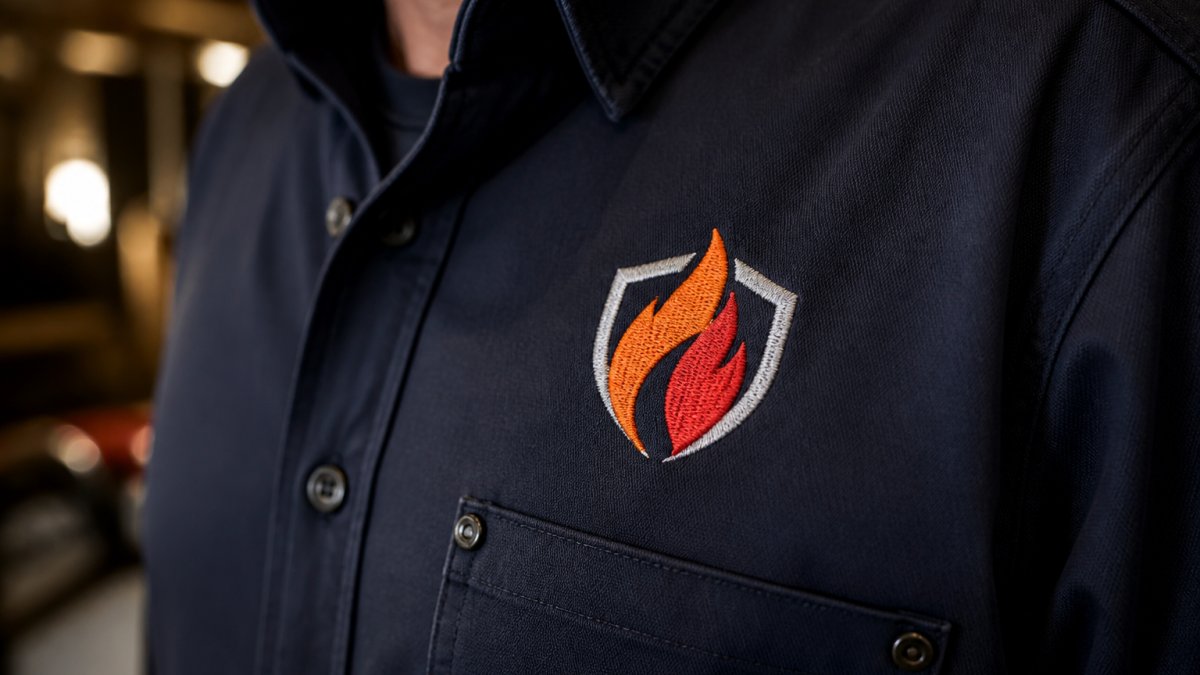
Embroidered FR Workwear: Professional Branding That Lasts
Embroidery is the gold standard for professional FR workwear branding. Thread is stitched directly into the garment fabric, creating a three-dimensional, tactile logo that looks premium and lasts as long as the garment itself.
FR Thread and Backing Considerations
Not all embroidery thread suits FR clothing.
The backing, the stabilizing material behind the embroidery, is critical: the wrong type can reduce flame-resistant properties.
Embroidery costs more than screen printing for small quantities but is competitive for medium to large orders. Digitization setup fees typically run $30-75, and minimum orders of 12-24 pieces make it accessible for smaller crews.
Logo Size and Placement for Maximum Impact
Embroidery quality depends on size and complexity. Logos smaller than 1 inch across stitch poorly and fine details blur.
Avoid high-heat exposure areas. The chest on a shirt and the thigh on pants work well; skip sleeve cuffs and collar edges, where friction and heat exposure are highest during welding or arc flash incidents.
Does Customization Affect Flame-Resistant Performance?
The short answer: no, when done correctly, customization does not compromise FR performance. The longer answer requires understanding how FR ratings work and what quality control means.
Arc-Rated and Flame-Resistant Fabric Standards
Flame-resistant clothing is tested and rated according to standards set by the American Society for Testing and Materials (ASTM).
When a garment is decorated, the process itself is tested to ensure it doesn't reduce the arc rating.
The risk comes from non-FR-compatible materials or incorrect application: a standard polyester ink applied at the wrong temperature, or thread that melts at FR-relevant temperatures, could create a weak point.
Quality Control Checks Before Delivery
At The Goods ND, every custom order undergoes quality control checks before shipping, ensuring your custom apparel is crafted with care and precision.
Ask your printer directly: Do you test decorated samples for compliance, and can you provide documentation? For arc-rated garments, there should be test results showing printed or embroidered areas maintain the original arc rating.
FR Clothing Care Instructions and Decoration Lifespan
Proper care extends the life of both your custom FR garment and its decoration.
Men's Customizable FR Long Sleeve Shirt →
Washing and Drying Best Practices
Wash FR garments separately in cool or warm water (not hot) with a mild detergent free of bleach or optical brighteners.
Dry on low heat or air dry.
Avoid fabric softeners and dryer sheets, which leave residues that interfere with flame resistance, and skip starch or sizing, which can create flammable buildup on the fabric surface.
How Prints and Embroidery Hold Up Over Time
Screen-printed logos typically survive 50+ wash cycles with minimal fading, embroidered designs last even longer, and heat transfer prints begin showing wear around 20-30 wash cycles.
Embroidery backing can occasionally separate under extremely aggressive washing, but this is rare with FR-compatible backing. If it happens, the embroidery itself remains intact; only the backing needs replacement.
Choosing the Right Garment Type for Custom Printing
Not all FR garments suit every decoration method. Fabric composition, weight, and intended use all affect which printing, embroidery, or heat transfer approach works best.
FR Shirts, Pants, Jackets, and Coveralls
FR shirts are the most common choice for custom branding: versatile, visible, and durable. The Goods ND offers Men's Customizable FR Long Sleeve Shirts, including our 88/12 cotton-polyester blend at $47.00, which accepts screen printing, heat transfer, and embroidery well.

FR pants work for embroidery and screen printing but are less ideal for heat transfer due to the larger surface area and difficulty of pressing evenly.
The choice depends on use case: high-heat crews (welding, arc flash risk) benefit from full-body coveralls, electrical contractors often prefer shirts and pants for flexibility, and construction teams might choose jackets with embroidered logos.
Practical Considerations by Work Environment
Where arc flash risk is frequent, embroidery is the safest decoration because stitching introduces no non-FR materials. Screen printing with FR-compatible inks is also reliable and more cost-effective for large orders.
Consider laundering frequency too. Daily industrial washing favors screen printing or embroidery for appearance; with less frequent or gentle in-house washing, all three options perform well.
Pre-Order Checklist and Approval Process
Getting custom FR workwear right requires clear communication and verification at every step. Use this checklist before ordering.
What to Verify Before Placing Your Order
Design and Placement: Confirm exact logo size, position, and orientation. Provide a high-resolution file (at least 300 DPI) and discuss color matching.
Garment Specifications: Verify the exact FR garment model, fabric composition, and arc rating (if applicable).
Costs and Timeline: Get a written quote breaking down garment price, decoration cost, setup fees, and minimums.
Turnaround Times and Shipping
Standard turnaround for screen-printed or embroidered FR clothing is typically 10-15 business days from approval; heat transfer orders often complete in 5-7 business days.
Most FR workwear orders ship via standard ground, arriving in 3-7 business days; expedited shipping is worth the cost for tight deadlines.
The Goods ND provides competitive pricing and fast turnaround on all custom FR workwear.
| Decoration Method | Setup Fee | Minimum Order | Durability | Best For |
|---|---|---|---|---|
| Screen Printing | $50-150 | 24-48 pieces | 50+ wash cycles | Large orders, long-term wear |
| Heat Transfer | $0-30 | 1 piece | 20-30 wash cycles | Small orders, quick turnaround |
| Embroidery | $30-75 | 12-24 pieces | 100+ wash cycles | Professional appearance, durability |
Getting custom FR workwear right means matching the decoration method to your crew's needs, verifying compliance before ordering, and choosing a printer who takes quality seriously. The Goods ND specializes in high-quality custom apparel printing, including FR work gear. Learn more about FR workwear standards from ASTM International to understand the compliance landscape, and reach out to us with your specifications.
Frequently Asked Questions
Can printing on flame resistant clothing affect its protective properties?
No, when done correctly. Printing on FR clothing should not compromise flame-resistant properties if the decoration method uses FR-compatible inks and processes that don't damage the protective fabric. Screen printing, embroidery with FR thread and backing, and heat transfer applied at proper temperatures all preserve arc-rated and flame-resistant fabric ratings. The key is working with a printer experienced in FR garments who understands compliance standards and uses quality controls to verify protection remains intact after decoration.
Which printing method is best for embroidered FR workwear?
Embroidery is ideal for durable, professional FR workwear branding because stitching doesn't fade or crack like prints can. Use FR-rated thread and FR backing to maintain safety standards. Embroidery works best for logos, names, and department text on FR shirts, jackets, and uniforms. It's more durable than screen printing for heavy-use workwear, though it costs more upfront. For larger graphics or full-color designs, screen printing or heat transfer may be more practical, but embroidery is unmatched for longevity and professional appearance on FR clothing.
How should I care for printed or embroidered flame-resistant clothing?
Follow FR clothing care instructions closely: wash in warm water (not hot), use mild detergent, and avoid fabric softeners and dryer sheets, which can coat the fabric and reduce flame resistance. Tumble dry on low heat or hang dry. Avoid bleach and harsh chemicals. For embroidered pieces, turn the garment inside out before washing to protect stitching. Inspect prints and embroidery regularly for signs of wear. Proper care preserves both the decoration and the FR protective properties, extending the life of your custom workwear significantly.
What's the difference between screen printing and heat transfer on FR clothing?
Screen printing uses ink applied directly onto the fabric through a mesh screen, creating durable, long-lasting designs ideal for FR workwear. It handles multiple colors well and resists fading after many washes. Heat transfer applies pre-made designs to fabric using heat and pressure; it's faster and works for small orders or complex graphics, but can crack or peel after repeated washing and high-heat drying. For FR clothing that sees heavy use, screen printing typically outperforms heat transfer in durability, though both methods preserve flame-resistant properties when applied correctly.
Can you customize FR clothing with small orders, or do I need a minimum quantity?
The Goods ND works with orders of any size, including small quantities. Whether you need 30 custom FR shirts for a church group or 5 embroidered work shirts for a small crew, there's no order too small. This flexibility means you can get professional, branded FR workwear without bulk commitments. Check the pricing page for current rates on small orders, and ask about setup fees upfront.
What should I know about logo placement on FR garments?
Logo placement affects both appearance and durability on FR clothing. Chest placement on FR shirts is standard for company branding and stays visible during work. Sleeve placement works for smaller logos or employee names. Avoid placement over seams or stress points where embroidery or prints wear faster. Consider the garment type: FR jackets offer more surface area than shirts. Smaller logos (2-4 inches) generally hold up better than large graphics. Discuss placement with your printer to ensure your design balances visual impact with practical durability in your work environment.
How do I know if a printer has experience with flame-resistant clothing?
Ask about their experience with arc-rated and flame-resistant fabrics specifically. A reliable FR printer understands NFPA 70E standards (electrical safety) and other relevant compliance requirements, uses FR-compatible inks and threads, and performs quality control checks to verify protective properties remain intact after decoration. Request references from other customers who ordered custom FR workwear. The Goods ND undergoes thorough quality control checks on every order, ensuring your custom apparel is crafted with care and precision.