

5 Best Fabrics for Sublimation Printing Shirts
Table of Contents
- Why Fabric Choice Matters for Sublimation Printing
- How Sublimation Ink Bonds With Fabric
- Sublimation on 100% Polyester Shirts
- Sublimation on Polyester-Cotton Blend Shirts
- Sublimation on Cotton Shirts
-
Best Polyester Shirts for Sublimation: A Practical Comparison
- 1. 100% Polyester: Maximum Color Vibrancy
- 2. Microfiber Polyester: Premium Feel and Durability
- 3. 65/35 Polyester-Cotton: The Comfort-Leaning Workhorse
- 4. 50/50 Polyester-Cotton: The Balanced Choice
- 5. Cotton: Why It Does Not Work
- How fabric construction changes the outcome
- Matching fabric to garment use
- Light-Colored vs. Dark-Colored Shirts: What Works Best
- Minimum Polyester Content for Usable Results
- Frequently Asked Questions
Last Updated: October 19, 2026
Why Fabric Choice Matters for Sublimation Printing
Getting the right fabrics for sublimation printing is the difference between a vibrant, durable print that lasts for years and a faded mess after a few washes.
Polyester content, fiber construction, and fabric weight all determine how the transfer takes hold and performs over time.
This guide breaks down the five best fabrics for sublimation printing shirts and gives you a practical framework for picking the right one.
How Sublimation Ink Bonds With Fabric
Sublimation printing is a heat-activated chemical process: under pressure, sublimation ink converts from solid directly to gas, penetrating polyester fibers and becoming part of the fabric rather than sitting on top like screen printing ink.
Polyester is the gold standard because its synthetic polymer structure has microscopic gaps that let the ink gas penetrate deeply.
Most sublimation presses run 350-400 degrees Fahrenheit for 45-90 seconds. The higher the polyester content, the more reliably the ink bonds and the more vibrant your colors.
Sublimation on 100% Polyester Shirts
Pure polyester is the ideal canvas for sublimation printing. With no natural fibers to interfere, ink penetrates uniformly, colors come out vivid, and the print resists fading through dozens of wash cycles.
The tradeoff is comfort: 100% polyester can feel plastic-like and doesn't breathe like cotton blends. If your end user cares more about durability and color vibrancy than comfort, it's your answer.
For promotional gear, athletic wear, or outdoor-event designs where durability matters more than everyday comfort, 100% polyester delivers.
Sublimation on Polyester-Cotton Blend Shirts
The 50/50 polyester-cotton blend is the workhorse of custom sublimation apparel: enough polyester to accept ink reliably, plus the comfort and breathability of cotton.
A 50/50 blend produces bright, saturated colors, not quite as vivid as pure polyester, with excellent durability and a softer, more wearable feel, making it ideal for everyday custom shirts.
The Goods ND offers several 50/50 blend options, including our Customizable T-Shirt, Gildan 50/50 Blend starting at $17.00. We also carry pre-designed 50/50 blend options like our Mother & Daughter Spanish tee at $20.00 and Jesus Refreshes the Soul at $25.00, both sublimation-printed on 50/50 blends.


Sublimation on Cotton Shirts
Pure cotton is not recommended for sublimation printing: cotton fibers don't accept sublimation ink the way polyester does.
If a customer insists on cotton, you're fighting a losing battle: colors will never be as bright, durability will be poor, and complaints are likely.
If comfort is the priority, stick with polyester blends, a 50/50 or 65/35 gives you softness while preserving the sublimation ink bond.
Best Polyester Shirts for Sublimation: A Practical Comparison
Here are five fabrics, ranked by how well each performs for sublimation shirts, with the trade-offs that actually matter when you are choosing a blank.
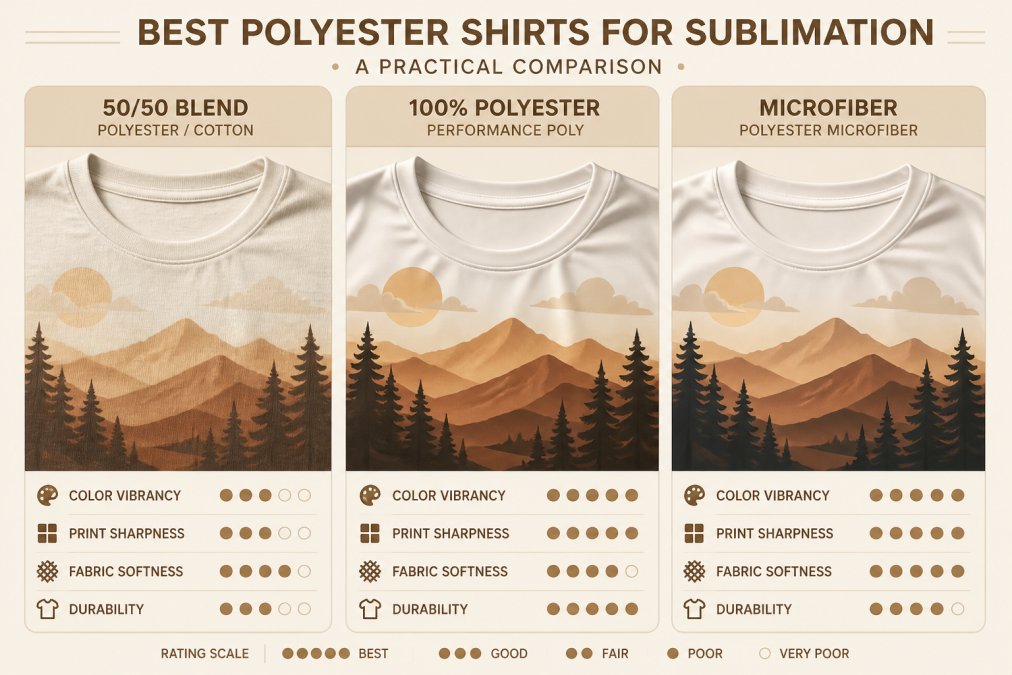
| Fabric Composition | Color Vibrancy | Durability | Comfort | Best Use Case |
|---|---|---|---|---|
| 100% Polyester | Excellent | Excellent | Fair | Athletic wear, outdoor gear, promotional items |
| Microfiber Polyester | Excellent | Excellent | Very Good | Premium custom apparel, resale and gifting |
| 65/35 Polyester-Cotton | Good | Good | Very Good | Casual wear, comfort-focused projects |
| 50/50 Polyester-Cotton | Very Good | Very Good | Excellent | Everyday custom shirts, gifts, events |
| Cotton (not recommended) | Poor | Poor | Excellent | Avoid for sublimation |
1. 100% Polyester: Maximum Color Vibrancy
Pure polyester is the reference standard: ink gas penetrates uniformly, colors come out at their most saturated, fine detail and gradients render crisply, and the print resists fading better than any blend.
The trade-off is hand feel: standard 100% polyester can read as slick or plasticky. The fix is construction, a mid-weight jersey knit (roughly 5.3-6 ounces) with a brushed or peached finish feels far more substantial than a thin performance knit.
2. Microfiber Polyester: Premium Feel and Durability
Microfiber is polyester spun into finer filaments, giving a softer, smoother surface that accepts sublimation ink beautifully. Color depth matches standard 100% polyester, but the fabric feels more premium, and fine detail holds especially well thanks to full transfer-paper contact.
Microfiber is right for resale or gifting when the product must justify a higher price. The trade-off is cost, microfiber blanks run higher, compressing margins unless you price at a premium.
3. 65/35 Polyester-Cotton: The Comfort-Leaning Workhorse
A 65/35 blend sits just above the practical floor for reliable sublimation. Colors come out good rather than brilliant, durability is solid, and the higher cotton content gives a softer, more traditional feel than 50/50, ideal for customers who prioritize comfort but still want a sublimated design that holds up.
Expect slightly muted saturation, and avoid subtle pastels or fine photographic gradients where the cotton content shows. Bold logos, simple graphics, and text-heavy designs perform well on 65/35.
4. 50/50 Polyester-Cotton: The Balanced Choice
A 50/50 blend is the most common sublimation blank for good reason: ink bonds predictably, prints are vibrant enough, and the cotton keeps the shirt soft and breathable for all-day wear.
It's the best starting point for beginners and the safest choice for mixed orders. Color vibrancy tops out at "very good," so reserve 50/50 for designs where comfort and wearability are the selling points.
5. Cotton: Why It Does Not Work
Pure cotton is not a sublimation fabric: it lacks the polymer structure that accepts ink gas, so the ink sits on the surface and washes away quickly. If a customer insists on cotton, switch printing methods, DTF transfer adheres to cotton and produces durable full-color prints, rather than promise results the fabric cannot deliver.
How fabric construction changes the outcome
Fiber content is only half the story. Construction determines how well the transfer paper contacts the fabric and how the finished print looks:
- Knit vs. weave. Knit shirts (jerseys, interlock) stretch and conform to the press, giving even contact. Woven fabrics can produce uneven transfer if the surface is not perfectly flat.
- Surface texture. Smooth, tight surfaces hold fine detail and gradients. Looser knits and textured surfaces can show a faint mottling on large solid-color areas.
- Fabric weight. Lightweight fabrics (under about 4 ounces) can feel thin and may scorch more easily under the press. Mid-weight fabrics (roughly 5.3-6 ounces) offer a better margin for error and a more substantial finished product.
Matching fabric to garment use
- Sportswear and athletic wear: 100% polyester or microfiber, moisture handling and durability matter most.
- Everyday custom shirts: 50/50 blend, the best comfort-to-print-quality ratio.
- Comfort-focused casual wear: 65/35 blend, softer hand, acceptable print quality for bold designs.
- Premium resale and gifting: microfiber, the feel justifies the price.
[]
Light-Colored vs. Dark-Colored Shirts: What Works Best
Sublimation printing works best on light-colored shirts, particularly white.
Dark-colored shirts present a challenge: sublimation ink doesn't cover dark backgrounds the way screen printing does.
Dark shirts aren't impossible, adjust expectations and design accordingly: use darker, more saturated colors, avoid pastels, and consider a white underbase if the design allows it.
For best results, stick with white, light gray, or pale pastel shirt colors. These backgrounds let sublimation ink shine and produce the vibrant prints customers expect.
Minimum Polyester Content for Usable Results
There's no single magic percentage, but results fall into predictable bands based on polyester content, knowing those bands is more useful than memorizing one number.
What to expect at each polyester ratio
| Polyester Content | Expected Color Vibrancy | Wash Durability | Hand Feel | Practical Verdict |
|---|---|---|---|---|
| 100% polyester | Excellent | Excellent | Fair to good (varies by construction) | Best for vivid, long-lasting prints |
| 90-99% polyester | Excellent | Excellent | Good | |
| 65-89% polyester | Very good | Very good | Very good | |
| 50-64% polyester | Good | Good | Excellent | Usable, but expect slightly muted color and faster fade |
| 35-49% polyester | Fair | Fair | Excellent | |
| Under 35% polyester | Poor | Poor | Excellent |
These bands are rules of thumb: a 60% polyester jersey knit can outperform a 70% ring-spun tee if the knit is tighter and smoother, because construction affects transfer contact as much as fiber content.
The variables that shift the threshold
Four factors shift results within the same polyester percentage:
- Fabric color. White and light blanks show true color; dark blanks mute everything regardless of polyester content. A 100% polyester black shirt will look worse than a 65% polyester white shirt for most full-color designs.
- Knit and weave density. Tighter, smoother surfaces hold fine detail and gradients better. Looser, textured knits can produce a slightly mottled look on photographic designs.
- Fiber diameter and finish. Microfiber and fine-denier polyester accept ink more evenly than coarse standard polyester, which can show a faint texture through large solid color areas.
- Ink and paper pairing. Transfer paper quality and ink volume interact with fabric absorbency. A low-bleed paper on a 60% blend often beats a cheap paper on 100% polyester.
A practical testing workflow
Before committing a full run to a new blank, press a test swatch with a solid color block, gradient, fine linework, and small text at your normal settings, then evaluate:
- Immediately after pressing, check color saturation, edge sharpness, and whether fine detail held.
- After one wash, use the care instructions you plan to print on the garment; look for fading, cracking, or ghosting.
- After five washes, this is where low-polyester blends separate from high-polyester options. If the print still looks close to the original, the blank is viable.
If a test print looks faded or uneven, raise press temperature within the fabric's safe range, increase dwell time slightly, or switch to a smoother, lighter-colored blank. Don't crank pressure, it flattens the texture and creates a shiny, pressed-flat look.
Why the 50/50 blend still works
A 50/50 blend sits in the "good" band, not "very good," but remains the most popular sublimation blank for everyday shirts because the comfort gain outweighs the modest color loss. Sell 50/50 as a comfortable everyday shirt with solid print quality, and reserve 100% polyester or microfiber for maximum-vibrancy designs. Matching the blank to the promise prevents complaints, not chasing a single polyester percentage.
Frequently Asked Questions
What is the best fabric to sublimate on a shirt?
Polyester is the best fabric for sublimation printing because sublimation ink chemically bonds with polyester fibers at high temperature and pressure. 100% polyester delivers the most vibrant colors and longest-lasting prints, but 50/50 polyester-cotton blends offer a practical balance of print quality, comfort, and cost. Cotton alone does not work well for sublimation because the ink sits on the surface rather than bonding permanently.
Can I sublimate on 50% cotton and 50% polyester?
Yes, you can sublimate on 50/50 polyester-cotton blends, and they're widely used for custom apparel. The polyester content allows the sublimation ink to bond and create vibrant colors, while the cotton adds breathability and comfort. However, color saturation won't match 100% polyester, and durability after repeated washing is slightly lower. For best results on a 50/50 blend, use quality transfer paper and ensure proper heat and pressure settings during printing.
What polyester percentage is best for sublimation shirts?
The higher the polyester content, the more vibrant and durable your print will be. Many crafters and small businesses choose 50/50 blends as a compromise between print quality and garment comfort, but they require careful temperature control.
Can you sublimate on cotton shirts?
Pure cotton is not suitable for sublimation printing. Sublimation ink requires polyester fibers to form a permanent chemical bond at high temperatures. On 100% cotton, the ink will not adhere properly and will wash out quickly or appear faded. If you want to sublimate on a cotton-based garment, choose a polyester-cotton blend instead.
Do sublimation prints fade or wash out?
Sublimation prints do not fade or wash out when applied to appropriate fabrics with proper technique. The ink chemically bonds with polyester fibers, making it incredibly durable. However, prints on low-polyester blends or on cotton may fade faster because the ink bond is weaker. Wash resistance improves with higher polyester content. For maximum longevity, use 100% polyester shirts and follow proper heat-transfer procedures during printing.